Electricity Consumption and Energy Conservation Measures
(Disclosure 302-1,302-2,305-2)
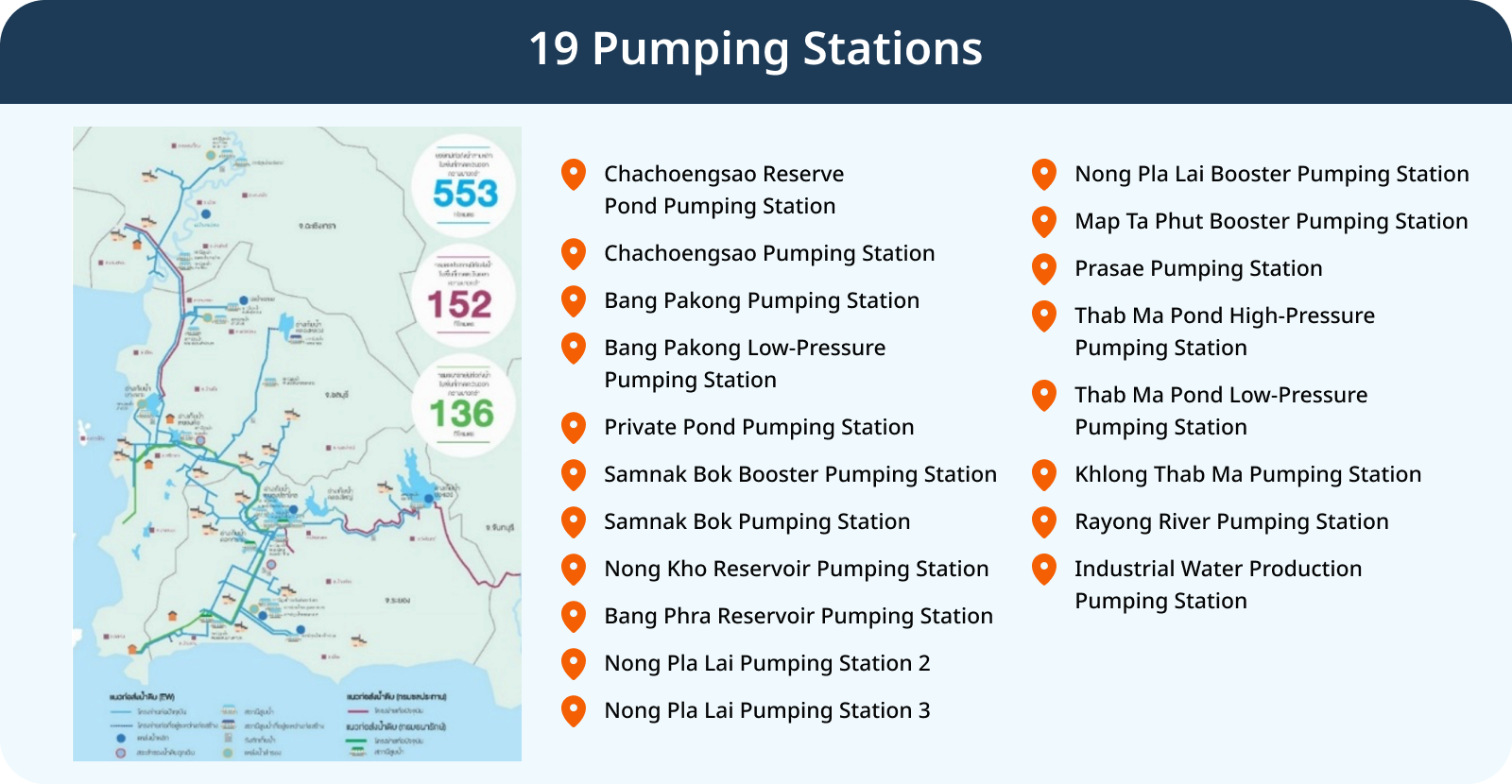
Electricity is a key factor in the operation of the water pumping and distribution system and also constitutes a major cost for the Company. Electricity consumption varies in accordance with the volume of water pumped through the water grid, which comprises 19 main pumping stations and 55 substations with water metering stations. Therefore, the Company places importance on maintaining the stability and continuity of the water pumping and distribution system (reliability) in order to support water demand from all user sectors. To achieve this, the Company has set a target to prevent damage to machinery and equipment that could cause interruptions to the water pumping and distribution system or result in water supply disruptions from the main water grid.
The Company has established criteria for planned water supply interruptions for maintenance to be limited to not more than eight hours per occurrence. For machinery or equipment classified as highly critical (Class A), no operational shutdown is permitted in order to maintain the long-term stability and reliability of the water infrastructure system.
In addition, the Company places importance on achieving maximum efficiency in energy use and has continuously implemented energy conservation projects in both the water pumping and distribution process and office buildings in order to reduce energy consumption while improving energy efficiency across the Group through the Energy Management Working Group. This not only helps manage the Company’s operating costs but also contributes to mitigating “global warming.” The Company’s energy conservation initiatives cover the Group’s energy consumption in the following areas:
- 11 pumping stations registered as controlled factories including:
Nong Pla Lai Pumping Stations (2–3), Bang Pakong Pumping Station / Bang Pakong Low-Pressure Pumping Station, Chachoengsao Pumping Station, Bang Phra Reservoir Pumping Station, Samnak Bok Booster Pumping Station, Prasae Pumping Station, Nong Kho Pumping Station, Thab Ma Pond High-Pressure Pumping Station / Thab Ma Pond Low-Pressure Pumping Station, Khlong Thab Ma Pumping Station, Rayong River Pumping Station, and Industrial Water Production Pumping Station. In addition, two pumping stations are currently under registration as controlled factories, namely Nong Pla Lai Booster Pumping Station and Map Ta Phut Booster Pumping Station. - 1 controlled building
i.e., the Head Office Building. Each year, energy conservation targets are determined based on the results of the previous year’s energy conservation potential assessment in order to reduce energy consumption in the following year at the organizational, production or service, and equipment levels, taking into account the level of energy loss and opportunities for improvement. - 55 power substations.
- 17 water supply and other operations of UU Public Company Limited (UU PCL), including industrial water production systems, wastewater treatment systems, and reclaimed water systems.
Summary of Operations of Energy Consumption Efficiency Enhancement Projects in 2025 (Disclosure 302-4, 305-2, 305-5)
Electricity Conservation Measures for 2025
| Premises | Projects | Before Improvement (kWh/y) |
After Improvement (kWh/y) |
Electricity saving (kWh/y) |
|---|---|---|---|---|
| Head Office | 1. Replacing water pumps with high-efficiency models | 96,271.50 | 71,220.74 | 25,050.76 |
| 2. Application of ozone system together with aeration tower | 488,231.74 | 483,712.18 | 4,519.56 | |
| 3. Maintenance of split-type air conditioning units | 230,609.39 | 223,691.10 | 6,918.28 | |
| 4. Cooling tower efficiency improvement | 483,601.63 | 476,347.61 | 7,254.02 | |
| Total | 1,298,714.26 | 125,4971.63 | 43,742.63 | |
| CO₂ emissions (kg-CO₂eq) | 616,889.27 | 596,111.52 | Reduction in CO₂ emissions: >20,777.75 kg-CO₂eq |
|
| Operating sites Nong Pla Lai Pumping Stations (2–3), Bang Pakong Pumping Station, Prasae Pumping Station, Thab Ma Pond High-Pressure Pumping Station, Bang Phra Reservoir Pumping Station, and Industrial Water Production Pumping Station. Five stations are exempted from implementing legally required energy conservation measures, namely: Chachoengsao Pumping Station, Khlong Thab Ma Pumping Station, Samnak Bok Booster Pumping Station, Rayong River Pumping Station, and Nong Kho Pumping Station. |
1. Reduction of air-conditioning operating hours | 49,285.90 | 45,019.40 | 4,266.50 |
| 2. Replacement with energy-saving lighting | 2317.90 | 1,419.12 | 898.78 | |
| 3. Maintenance of air-conditioning systems | 242,285.99 | 237,535.28 | 4,750.71 | |
| 4. Replacement of air-conditioner compressor | 78,840.00 | 43,800.00 | 35,040.00 | |
| Total | 372,729.79 | 327,773.80 | 44,955.99 | |
| CO₂ emissions (kg-CO₂eq) | 177,046.65 | 155,692.56 | Reduction in CO₂ emissions: 21,354.09 kg-CO₂eq |
|
| UU Public Company Limited Head Office, Bangpakong Water Supply Co., Ltd., Chachoengsao Water Supply Co., Ltd., Nakornsawan Water Supply Co., Ltd., Egcom Tara Co., Ltd., Rayong Tap Waterworks, Sattahip Waterworks, Bo Win Waterworks, Hua Ro Waterworks, Chonburi Waterworks, and Nong Kham Waterworks |
1. Replacement with high-efficiency motors | 2,372,133.00 | 2,228,302.62 | 143,830.38 |
| 2. Replacement of fluorescent lighting with LED | 146,229.75 | 65,377.40 | 80,852.35 | |
| 3. Improvement of pump suction pipes to reduce motor load | 171,465.70 | 145,937.31 | 25,528.39 | |
| 4. Installation of inverter systems for water pumps | 3,477,325.43 | 2,078,360.65 | 1,398,964.78 | |
| 5. Installation of VSD systems for high-pressure water pumps | 3,131,069.19 | 2,586,795.00 | 544,274.19 | |
| Total | 9,298,223.07 | 7,104,772.98 | 2,193,450.09 | |
| CO₂ emissions (kg-CO₂eq) | 4,416,655.96 | 3,374,767.17 | Reduction in CO₂ emissions: 1,041,888.79 kg-CO₂eq |
Based on energy-saving measures in 2025, all facilities achieved a total reduction in CO₂ emissions of 1,084.02 tons.
The calculation was based on the Thailand Greenhouse Gas Management Organization (TGO)’s Emission Factor (www.tgo.or.th)
The Company has continuously formulated an energy conservation and innovation development plan in 2026 as follows:
- Maintenance of split-type air conditioners
- Improving the efficiency of split-type air conditioners
- Reducing leakage in the compressed air system. The target is to reduce energy consumption by 3.00% per year.
Measures of Solar Energy as an Alternative to Electricity for 2022–2025 (Disclosure 305-5)
| Premises | Option | Operation Period (๋Jan - Dec) | |||
|---|---|---|---|---|---|
| 2022 | 2023 | 2024 | 2025 | ||
| The Company | |||||
| Head Office | SOLAR ROOFTOP SYSTEM (kWh/y) | 26,955.00 | 25,621.00 | 25,482.00 | 19,435.00 |
| Operation areas (pumping stations) | 0 | 0 | 6,970.58 | 133,826.74 | |
| UU Public Company Limited | |||||
| Pang Puay Water Production Station, Ratchaburi Waterworks | SOLAR ROOFTOP SYSTEM (kWh/y) | 302,503.86 | 209,362.60 | 209,362.00 | 499,010.00 |
| Pluak Daeng Industrial Water Production Station | 0 | 0 | 0 | 43,603.87 | |
| Amata City Rayong Industrial Water Production Station 2 | 0 | 0 | 0 | 13,740.00 | |
The calculation was based on the Thailand Greenhouse Gas Management Organization (Public Organization) (TGO)’s Emission Factor (www.tgo.or.th)
In 2026, the Company will continue to promote the use of solar energy as an alternative to electricity consumption, which contributes to greenhouse gas emissions and global warming, at two stations as follows:
| No. | Station | Production Capacity (kW) | Energy Consumption (kWh/year) | Remarks |
|---|---|---|---|---|
| 1 | Bang Phra Pumping Station | 116.42 | - | Currently in the process of obtaining approval for construction site usage |
| 2 | Prasae Pumping Station | 3,032.64 | - | Currently under installation |
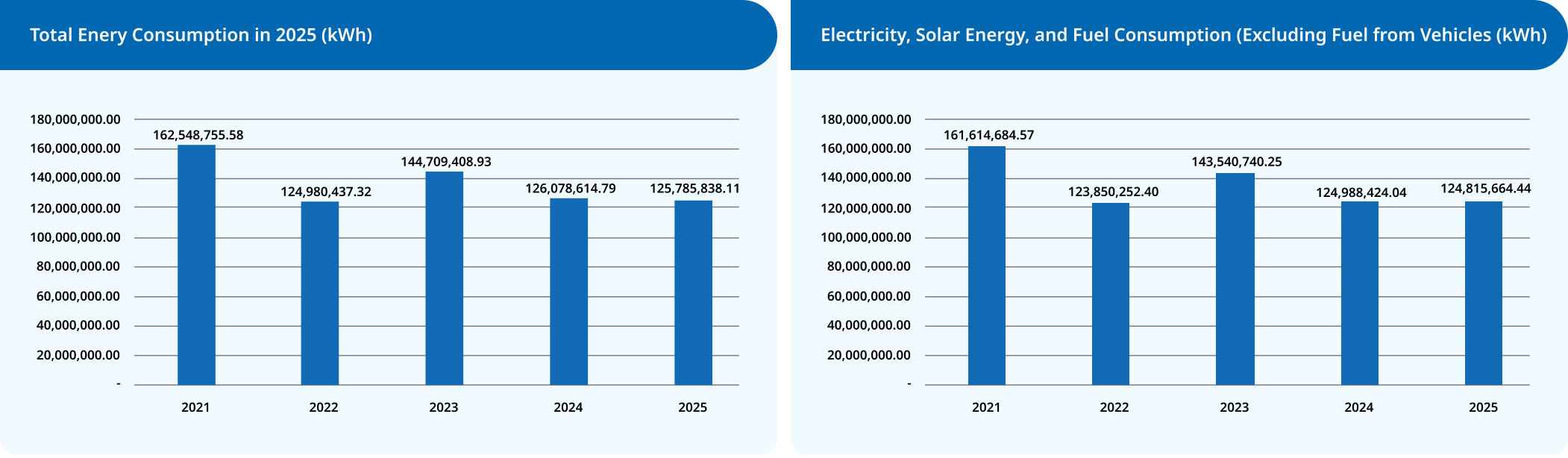
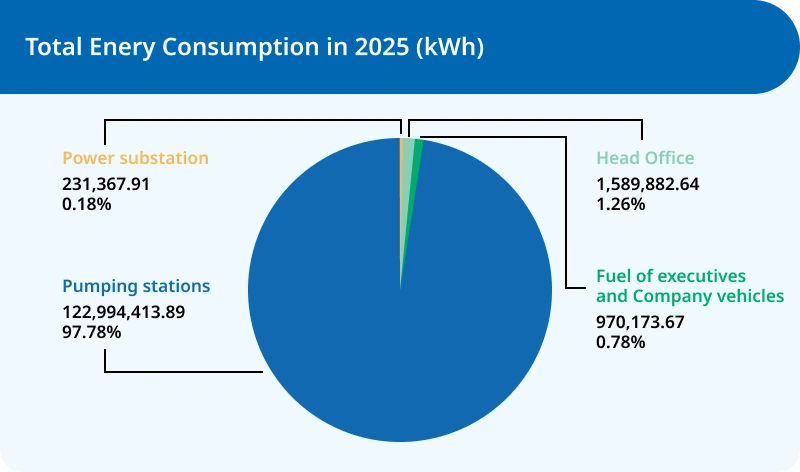
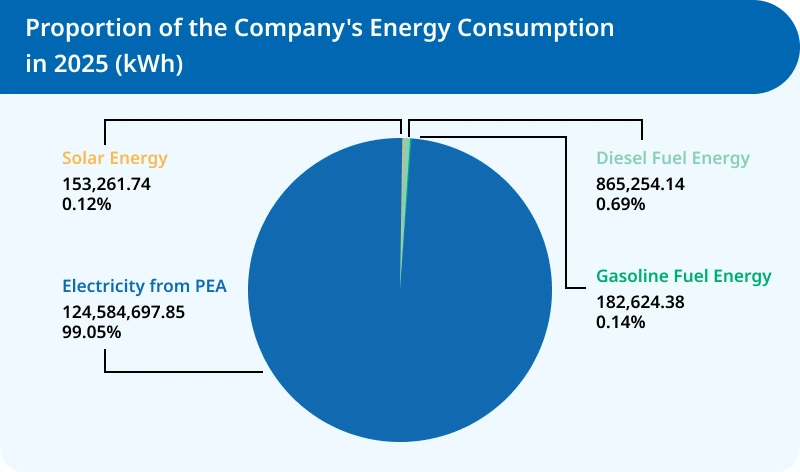
In summary, electricity and fuel consumption in 2025 comprised three forms of energy, namely electricity, solar energy, and fuel energy (diesel and gasoline), totaling 125,785,838.11 kWh, calculated from:
- Pumping stations: 122,994,413.89 kWh
- East Water Head Office building: 1,589,882.64 kWh
- Power substations along the Company’s pipeline network: 231,367.91 kWh
- Fuel of executive and Company vehicles: 96,824.74 liters, equivalent to 3,489,833.33 megajoules or 970,173.67 kWh
Energy Efficiency and Energy Intensity (Disclosure 302-3, 302-5)
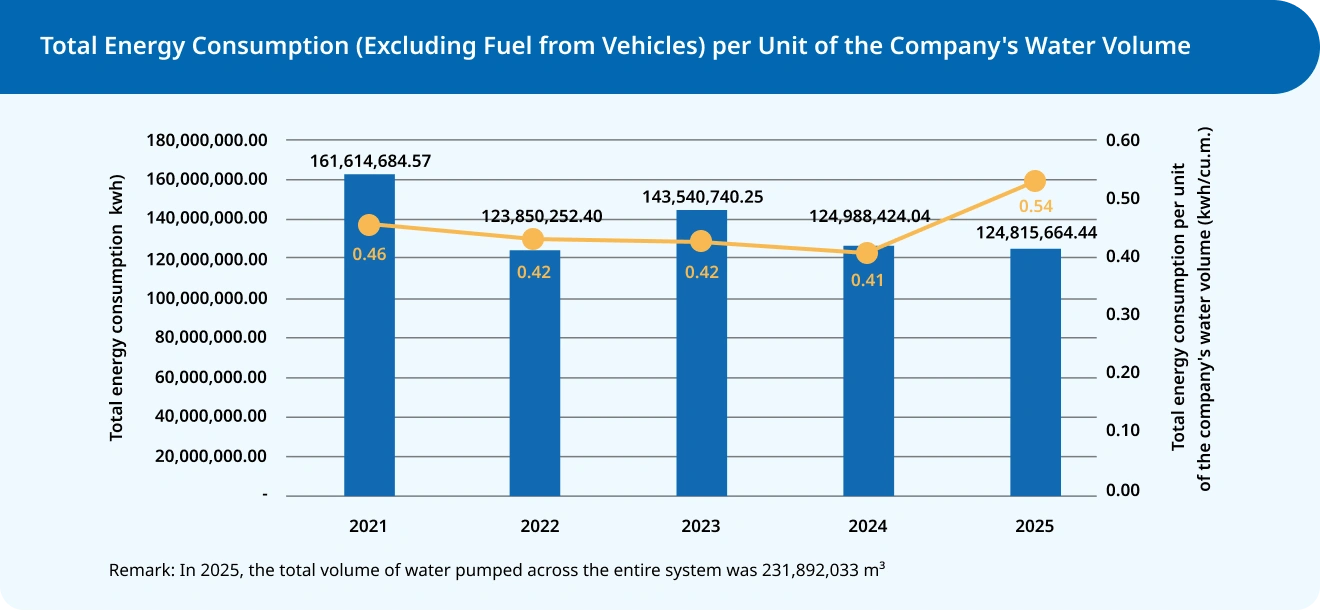
In 2025, the Company’s total energy consumption decreased by 292,776.68 kWh compared with 2024, representing 0.23% of the total energy consumption in 2024. This reflects the Company’s continuous efforts to manage and control energy consumption.
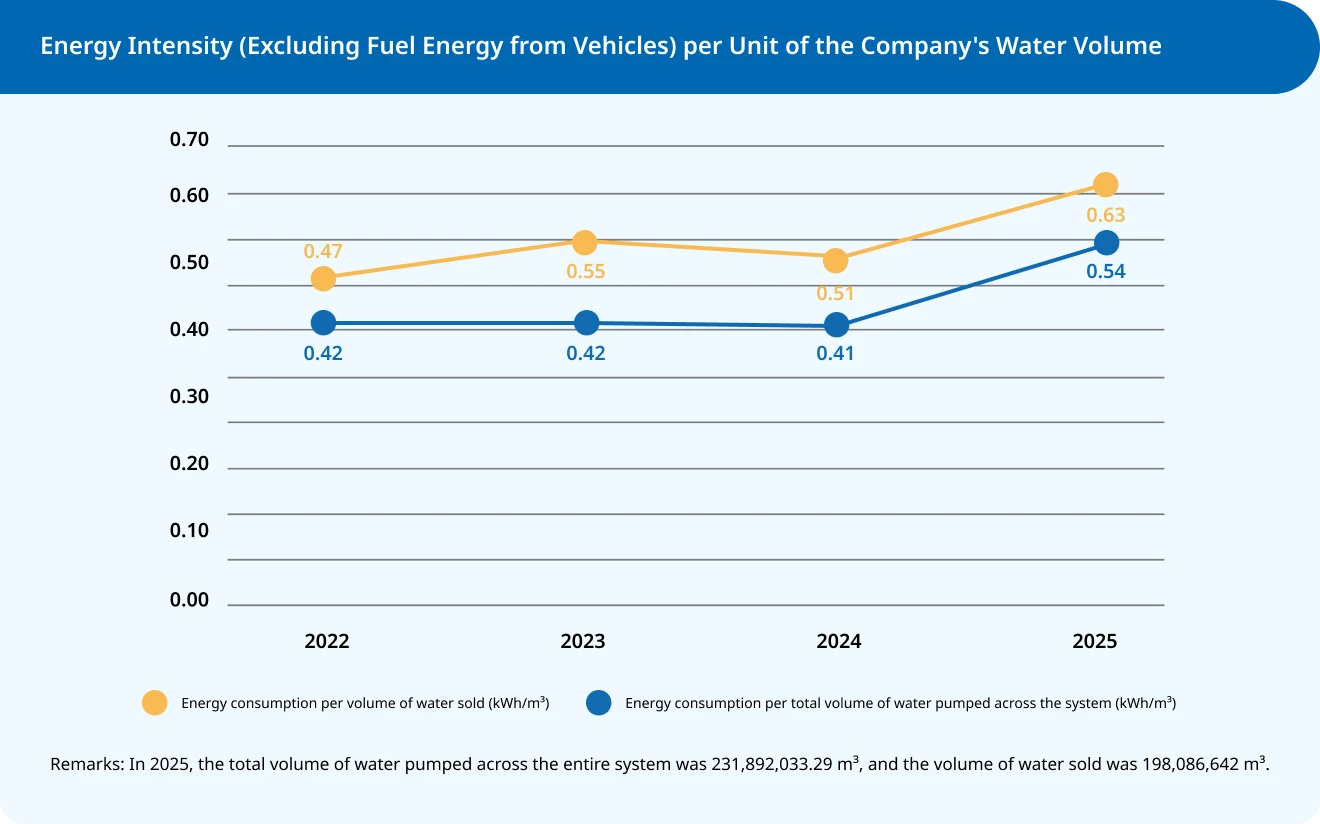
However, when considering energy intensity, which reflects the efficiency of energy consumption per unit of water pumped and distributed across the entire system, the Company’s energy consumption (excluding fuel energy from vehicle use) per unit of water pumped and distributed across the system was 0.54 kWh per cubic meter (kWh/m³), representing an increase of 31.71% compared with 2024.
For energy consumption per unit of water sold (excluding fuel energy from vehicle use), the figure was 0.63 kWh per cubic meter (kWh/m³), representing an increase of 22.58% compared with 2024.
The increase in energy intensity was mainly attributable to the expansion of water pumping and distribution through newly completed pipeline networks in 2025. This expansion was undertaken to enhance system stability and reduce reliance on external water sources. Although this resulted in higher energy consumption per unit of water in the short term, it represents an investment to strengthen long-term water resource security.