

Care for Biodiversity
The Company is committed to ensuring water security and maintaining the stability of water sources in order to build confidence among stakeholders while fulfilling its responsibilities toward communities, society, and the environment. As water is a vital natural resource for all forms of life, the Company therefore places importance on biodiversity management and conducts its business with awareness of potential impacts on biodiversity throughout the supply chain. The Company has established measures to prevent, avoid, and reduce the risk of adverse impacts by implementing activities in collaboration with government agencies and local communities to promote the conservation, protection, and restoration of biodiversity and maintain ecological balance. These activities include participation in meetings with government agencies and water user groups through the Keyman Water War Room, community forest planting, releasing aquatic species into natural water sources, establishing model schools with canteen wastewater treatment systems, and developing youth networks under the East Water Youth Water Stewardship Network to monitor and protect water sources.
In 2025, the Company announced a Biodiversity Management Policy to demonstrate its commitment to addressing potential biodiversity impacts that may arise from its operations throughout the supply chain. Under this policy, the Company plans to conduct biodiversity risk assessments covering all operational areas. The Company also promotes communication, awareness building, and knowledge sharing among employees and stakeholders to foster a shared understanding of sustainable biodiversity conservation and restoration.
Study on Changes in Water Quality in Water Sources
The Company places importance on studying changes in water quality in order to monitor potential impacts from pumping and transmitting water through the Company’s raw water pipeline network, which may affect aquatic life in those water sources. The Company has established two approaches for water quality monitoring to ensure customer confidence and prevent potential damage to customers’ production processes (Disclosure 303-1:2018) as follows:
- Water Quality Monitoring by External Agencies The Company conducts water quality monitoring through external agencies at 13 monitoring points covering both the Company’s main and reserve water sources. Physical and chemical water quality parameters are monitored monthly. After receiving the monitoring results, the Company analyzes trends, causes, and factors that may affect changes in water quality. Reports are prepared and communicated to relevant internal departments as well as customer groups through the Customer Relations Department to support appropriate planning and water management.
- Online Water Quality Monitoring The Company has installed online water quality monitoring instruments at 20 key locations within the water pipeline system. Water quality conditions are monitored and evaluated through the Supervisory Control and Data Acquisition (SCADA) system, enabling continuous and timely monitoring of water quality conditions. The monitoring results are communicated to customers on a daily basis.
The Company also compares water quality monitoring results from various water sources with nine years of historical raw water quality data to track trends in water quality changes. Based on this monitoring and surveillance, the Water Quality Index (WQI) in 2025, referenced from the Pollution Control Department, indicates that the average water quality of most major reservoirs remains at a fair level.
| Dok Krai Reservoir | Nong Pla Lai Reservoir | Bang Phra Reservoir | Nong Kho Reservoir | Prasae Reservoir | Khlong Yai Reservoir | |||||||
|---|---|---|---|---|---|---|---|---|---|---|---|---|
| 2017 | 75 | Good | 68 | Fair | 74 | Good | 61 | Fair | 77 | Good | 63 | Fair |
| 2018 | 61 | Fair | 63 | Fair | 66 | Fair | 75 | Good | 68 | Fair | 61 | Fair |
| 2019 | 61 | Fair | 66 | Fair | 57 | Poor | 71 | Good | 72 | Good | 64 | Fair |
| 2020 | 64 | Fair | 66 | Fair | 65 | Fair | 76 | Good | 64 | Fair | 61 | Fair |
| 2021 | 65 | Fair | 75 | Good | 65 | Fair | 76 | Good | 75 | Good | 74 | Good |
| 2022 | 66 | Fair | 67 | Fair | 64 | Fair | 72 | Good | 74 | Good | 73 | Good |
| 2023 | 65 | Fair | 65 | Fair | 53 | Poor | 48 | Poor | 73 | Good | 61 | Fair |
| 2024 | 62 | Fair | 65 | Fair | 59 | Poor | 69 | Fair | 72 | Good | 66 | Fair |
| 2025 | 64 | Fair | 66 | Fair | 62 | Fair | 69 | Fair | 62 | Fair | 66 | Fair |
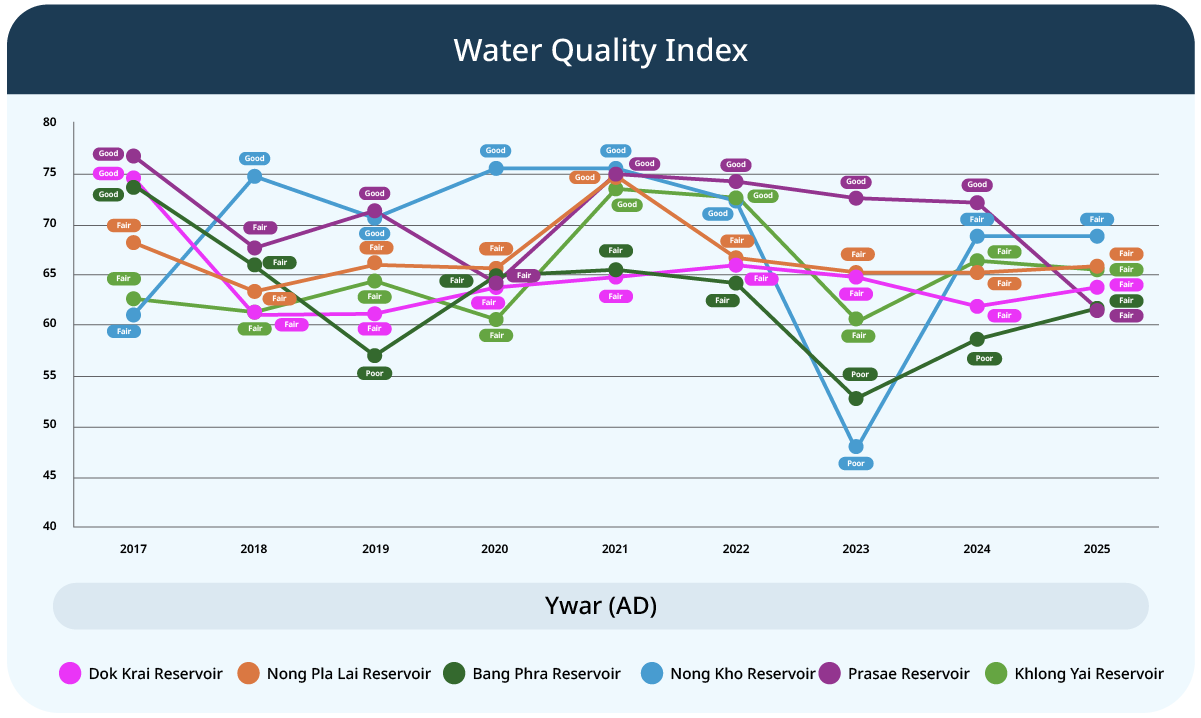
Based on the Water Quality Index (WQI) data above, the overall quality of raw water was found to remain within the standard for surface water quality. However, certain parameters such as electrical conductivity and Total Dissolved Solids (TDS) have shown an increasing trend each year. This has resulted in higher water demand for customers’ production processes, as some portions of raw water that do not meet the required quality must be discharged from the production system. If the water quality index continues to show an increasing trend, the available volume of raw water in reservoirs may become insufficient to meet demand. The Company has therefore developed additional measures to enhance water quality monitoring.
In addition, the Company and its customers have coordinated the monitoring of water quality at both upstream sources and downstream supply points delivered to each customer in order to enhance service efficiency and enable faster responses in improving water quality for customers, as follows:
- If the Company detects irregularities beyond the parameters monitored by the online monitoring system at the upstream water sources, the Company will notify customers so that they can monitor the situation and prepare for water quality adjustments before the water enters their production systems.
- If no irregularities are detected at the upstream sources but customers identify abnormalities in the water entering their production processes, customers will notify the Company so that the Company can investigate and adjust the system to restore water quality to normal conditions.
- Whenever adjustments are made to the water transmission and distribution system, the Company will inform customers of potential impacts in advance. All operational adjustments are carried out with consideration of potential impacts and customers’ water demand.
Promoting Biodiversity Activities in Collaboration with Government Agencies and Communities
- Agreement with Government Agencies and Communities on Pumping Water from the Bang Pakong River during the Flood Season
The Company has entered into agreements with government agencies in Chachoengsao Province and local communities regarding the period during which the Company may pump water from the Bang Pakong River. Water pumping can commence only when the salinity level is lower than 1 g/L, measured at the Ban Pho Monitoring Station, in order to minimize the impact of salinity on aquatic life. - Study of Biodiversity in the Bang Pakong River and Bang Phra Reservoir
The Company pumps water from the Bang Pakong River during the flood season and stores it in Bang Phra Reservoir in accordance with agreements with government agencies and local communities. Therefore, the Company has studied aquatic species data in the Bang Pakong River and Bang Phra Reservoir based on information from the Inland Fisheries Research and Development Division, Department of Fisheries, in order to support planning for biodiversity promotion activities. The study found that the Bang Pakong River contains 264 fish species, indicating high biodiversity. Among these, 20 species are considered rare species. From 2015 to 2024, surveys recorded fish species native to the Bang Pakong River. The number of species observed each year varies depending on seasonal conditions, particularly seawater intrusion into the river and rainfall that drives freshwater flow and pushes saline water downstream. Fish species in the Bang Pakong River include freshwater, brackish water, and marine species, which migrate upstream and downstream depending on seasonal salinity levels. In Bang Phra Reservoir, a total of 45 fish species from 18 families were recorded. The Cyprinidae family was the most abundant with 16 species. The fish community structure mainly consists of scaled fish. Frequently observed species include silver barb, giant barb, striped mystus, climbing perch, Nile tilapia, freshwater garfish, glass perchlet, and sand goby. - East Water Water Stewardship Network Project
The Company collaborates with the Environmental Warriors / Water Detective groups under the Chachoengsao Environmental Conservation Association and the Water Quality Monitoring and Inspection Center, Pluak Daeng District, Rayong Province. The objective of the project is to monitor, observe, and inspect water quality in the Bang Pakong River and other water sources in Rayong Province. . The Company also provides educational scholarships and support for scientific equipment to students in order to strengthen their academic skills. In addition, the Company participates in activities such as watershed forest restoration, releasing aquatic species into the Bang Pakong River, and organizing camps to promote knowledge on water quality monitoring. - Natural Resources and Water Source Restoration Project
Forest restoration is not limited to planting trees but aims to restore the entire ecosystem. This requires cooperation from all sectors, including government agencies, the private sector, and local communities. Healthy forests serve as important upstream water sources, helping absorb rainwater into the soil, slow down surface runoff, and reduce soil erosion, eventually forming small streams and natural waterways. Therefore, the Company collaborates with the Community Forest Network in the contiguous forest area of five eastern provinces to organize upstream forest restoration activities within the Company’s operational areas.