Human Resources Management
In 2025, the Company faced a challenging year as its business operations fully entered a competitive market environment, with new entrants emerging in the total water solutions market, resulting in significant changes in the competitive landscape. This situation may affect employee morale as personnel need to adapt in order to move forward with stability. Therefore, transparent and accurate communication, together with morale-building support from management, became one of the Company’s top priorities in 2025.
The Company places importance on human resources management alongside strengthening employee engagement by fostering a working environment that encourages participation in driving the organization forward. The Company recognizes that retaining talented and high-performing employees on a continuous basis is a key factor supporting long-term stability and competitiveness. Accordingly, the Company promotes employees’ career advancement through a variety of capacity development activities covering professional skills, leadership, and teamwork. Employees are also encouraged to demonstrate their potential and participate in projects or activities that are important to the organization.
The Company has continuously implemented various human resources management initiatives as follows:
Human Resources Management Process Improvement
Performance Management System
The Company has established a clear and structured Performance Management System that is aligned with the organization’s strategic goals (Corporate KPIs). The evaluation criteria and performance assessment methods are communicated annually to all employees across the organization to ensure shared understanding. Performance indicators are designed to be appropriate to the level of responsibility for each position and cover organizational outcomes, strategic achievements, competencies, and quality of work as follows:
- Corporate KPIs – Measure the Company’s operational performance compared with the targets set.
- Strategic KPIs – Measure the achievements of key annual activities or projects.
- Individual KPIs – Measure employee performance according to the responsibilities of each position.
- Common KPIs – Measure key annual performance outcomes for which all employees share responsibility.
- Core Competency (CC) – Assess desirable work behaviors expected of employees, with different levels depending on job positions.
- Managerial Competency (MC) – Assess managerial capabilities of employees at senior levels and above.
- Working Quality – Measure the quality of work delivered by employees to their departments and the organization.
Summary of Performance Evaluation Results in 2025 (Disclosure 404-3)
All employees have defined KPIs and have undergone performance evaluations. The percentage distribution of total employees is as follows:
- By gender: Male employees 50% and female employees 50%.
- By position level: Executives 8.64%, Supervisory level 17.72%, and Operational level 73.64%.
Care for Employees’ Well-being and Personnel Development Towards a Sustainable Water Organization (Disclosure404-2)
Personnel Capacity Development
Concept and Role of Human Resource Development
Human resources are considered a strategic factor that plays a vital role in operational capability, continuity of management, and the long-term credibility of the organization. Human resource development is therefore not merely a training activity but a systematic mechanism that is linked to corporate governance, risk management, and value creation for stakeholders.
The personnel development of the Company and UU PCL. is designed to cover the following areas:
- Strengthening knowledge and skills necessary for job performance
- Instilling discipline and work ethics
- Preparing the next generation of leaders
- Knowledge transfer to ensure organizational continuity
This approach enables personnel at all levels to perform their duties effectively within the framework of relevant laws, policies, and standards.
Human Rights (SHR24)
In 2025, the Company systematically integrated its human rights policy into its operations by requiring all employees to complete a human rights training course through the Company’s E-learning system. This aims to enhance awareness and understanding of human rights principles and to reduce the risk of potential human rights violations in the workplace.
The Company evaluates employees’ learning outcomes through post-training assessments, and the results are incorporated as one of the Key Performance Indicators (KPIs) to encourage the appropriate application of human rights principles in their work. The assessment scores are used in KPI evaluation based on defined achievement levels, with a score of 100% equivalent to a full score of 5 under the KPI rating scale.
| Unit | Employees Participating in Training | KPI Achievement Level (KPI = 5 points) | ||
|---|---|---|---|---|
| Number (Persons) | Percentage of Total Employees | Number (Persons) | Percentage of Total Employees | |
| The Company | 218 | 99.00 | 218 | 99.00 |
| UU PCL. | 12 | 100 | 12 | 100 |
Occupational Health and Safety (SHS13)
The Company provides occupational health and safety training, with content designed to align with job characteristics and the level of risk associated with each position. This aims to create a safe working environment, reduce workplace accidents, and continuously promote employees’ health and well-being.
The outcomes of such training not only enhance employees’ knowledge and understanding of safety but can also be applied in practice to ensure alignment with international standards. As a result, the Company has maintained strong safety performance, achieving a full score of 5 under the Common KPIs in the category of accident-free work resulting in no lost-time injuries (Goal Zero). This reflects the effective enhancement of occupational health and safety practices, with transparency and long-term social responsibility.
| Unit | Training Coverage | ||
|---|---|---|---|
| Number of Courses | Number of Participants (Persons) | Percentage of Total Employees | |
| The Company | 16 | 204 | 93.00 |
| UU PCL. | 15 | 140 | 96.55 |
Prevention of Workplace Bullying and Harassmen (SLS30)
The Company places importance on fostering a respectful working environment and upholding the dignity of all employees by establishing ethical principles and work discipline as the fundamental framework for working together.
Currently, the prevention and management of issues related to workplace bullying or harassment are governed under the Company’s policies on ethics, discipline, and human resource management, which cover appropriate practices and the handling of complaints in accordance with established organizational procedures. However, the Company is in the process of considering approaches to enhance communication and strengthen understanding of these issues in a more structured and systematic manner, with plans to develop appropriate guidelines or awareness-building activities that align with the Company’s operational context in the future.
Promotion of a Learning and Continuous Improvement Culture (KM Passport)
In 2025, the Company launched a knowledge-sharing campaign in the Water Library under the concept “Share Every Knowledge, Drive Improvement” #LeanYourWork #KaizenYourWay to encourage participation in knowledge management and continuous improvement. The KM Passport was adopted as a key mechanism to support collaborative learning within the organization and to promote a working culture of “Learn – Improve – Extend.”
The campaign provided employees with opportunities to participate in various forms, including sharing knowledge and lessons learned from actual operations, exchanging ideas and improvement suggestions, and applying knowledge to enhance work processes, along with reflecting the outcomes achieved. This ensures that learning goes beyond information exchange and can be translated into process improvements and enhanced operational efficiency.
Accordingly, the Company has integrated participation in KM Passport activities into the Key Performance Indicators (KPIs) of employees at all levels. This reflects expectations for continuous learning, knowledge sharing, and work improvement at the individual level, while supporting the development of an organizational culture that emphasizes learning and sustainable development.
The campaign results indicate that employees continuously participated in knowledge sharing and the exchange of improvement ideas. Most shared and developed knowledge focused on eliminating unnecessary steps, improving work methods, and enhancing operational efficiency, reflecting the practical application of Kaizen and Lean Management concepts in daily operations.
Investment in Personnel Development
In 2025, the Company and UU PCL. invested a total of 5,115,542 Baht in personnel development, equivalent to an average of 14,210 Baht per person per year. This investment reflects the Company’s commitment to continuous human resource development to enhance employees’ knowledge, capabilities, and potential in alignment with their roles and the organization’s strategic direction. The investment by entity is as follows:
| Unit | Training and Development Expense | Knowledge Management Expenses | ||
|---|---|---|---|---|
| The Company | 2,250,000.00 Baht | Average 10,227 Baht/person/year | 405,542.00.00 Baht | Average 1,843 Baht/person/year |
| UU PCL. | 1,760,000 Baht | Average12,138 Baht/person/year | 700,000.00 Baht | Average 4,828 Baht/person/year |
Remark:: The average cost per person per year is calculated based on the average number of employees throughout the year to reflect overall investment in personnel development across the organization.
Training Hours for Employee Skill Development
| Item | Description | The Company | UU PCL. |
|---|---|---|---|
| Total number of employees | As at year-end | 220 persons | 145 persons |
| Number of employees trained | All types | 220 persons | 145 persons |
| Percentage of employees trained | (% of total employees) | 100% of total employees | 100% of total employees |
| Total training hours | All courses | 5,525.38 hours | 5,239 hours |
| Average training hours per employee | Hours/person/year | 25.10 hours/person/year | 36.13 hours/person/year |
Linkage of Development with Career Advancement
The development of personnel capabilities at the growth stage is clearly linked to career advancement opportunities within the organization. The Company emphasizes internal growth by providing opportunities for high-potential employees to develop their knowledge and capabilities and progress to roles with greater responsibilities along appropriate career paths.
Based on statistics from 2022 to 2025, at least 10% of employees within the Group have been promoted or advanced each year. This reflects the effectiveness of the personnel development system and the systematic establishment of career advancement pathways. Such promotion of career progression forms part of the Company’s commitment to continuous and sustainable personnel development (Disclosure 404-3).
| Year | Total Employees (Persons) | Promotion (%) | By Gender (%) | |
|---|---|---|---|---|
| Male | Female | |||
| 2022 | 230 | 13.04 | 8.70 | 4.35 |
| 2023 | 227 | 18.50 | 7.49 | 11.01 |
| 2024 | 233 | 10.73 | 5.15 | 5.58 |
| 2025 | 220 | 12.27 | 7.27 | 5.00 |
Employee Welfare
Management
Employees are a key driving force in strengthening the Company’s business and ensuring long-term sustainability. Their ability to innovate and create value directly contributes to operational efficiency, competitiveness, and organizational stability. The Company therefore places importance on employee well-being, welfare, and engagement through a systematic approach.
Employee Welfare (Disclosure 401-2)
The Company provides a flexible welfare program designed to address the diverse needs of employees across different genders and age groups, with a focus on enhancing quality of life and supporting work–life balance, as follows:
- Medical expenses
- Life and health insurance premiums
- Child education assistance
- Child allowance
- Wedding allowance
- Sports center membership and recreational activities
- Hybrid working equipment support
- Housing and transportation assistance
Welfare Committee in the Workplace (Disclosure 2-30)
The Group conducts elections for the welfare committee in the workplace in accordance with the Labour Protection Act B.E. 2541 (1998). In 2025, the Group has three welfare committees as follows:
- The Company has two welfare committees:
- Head Office Welfare Committee
- Rayong Operations Center Welfare Committee
- UU PCL. has one welfare committee with 8 members, representing 5.52% of total employees
| Details | By Employee Level | By Gender | By Region | |||
|---|---|---|---|---|---|---|
| Operational | Supervisory | Male | Female | Central | Eastern | |
| The Company’s Welfare Committee (Head Office) | 4 | 1 | 2 | 3 | 5 | - |
| The Company’s Welfare Committee (Rayong Operations Center) | 4 | 1 | 3 | 2 | - | 5 |
| UU PCL. Welfare Committee | 8 | - | 3 | 5 | 5 | 3 |
Welfare for Retired Employees (Disclosure 201-3)
The Company recognizes that retired employees are valued individuals who have contributed significantly to building the Company’s foundation and long-term growth through their dedication and commitment. Upon reaching the retirement age of 60 and ceasing employment, the Company organizes activities to express appreciation for their contributions.
In addition, the Company places importance on the quality of life of retirees, particularly their health, which is a key concern at this stage of life. As part of the annual employee health check-up program, the Company collaborates with its partner hospitals to offer health check-up packages at appropriate rates for retirees. This initiative helps ease financial burdens and supports continued health care.
This approach reflects the Company’s care and sense of responsibility toward its personnel even after retirement. Feedback from retirees indicates appreciation for the Company’s continued attention and support, which helps maintain a positive relationship between the Company and its former employees.
Incorporation of Feedback from Various Channels for Improvement in 2025
The Company recognizes the importance of continuously strengthening relationships, motivation, and employee engagement. Accordingly, it has enhanced its approaches to support employees’ work and promote their well-being, enabling them to perform at their full potential.
Enhancement of Flexible Welfare
The Company has reviewed and improved its welfare policy to align with current conditions and the diverse needs of employees. In particular, following the enactment of the Marriage Equality Act, published in the Royal Gazette on 24 September 2024 and effective from 22 January 2025, the Company has ensured that all employees, including LGBTQ+ employees, receive equal benefits. These include core welfare, flexible welfare, and leave entitlements. This initiative reflects the Company’s commitment to promoting Diversity, Equity, and Inclusion (DEI) as an integral part of its organizational culture in a sustainable manner.
Development of Working Environment and Employee Well-being
Based on the 2024 employee satisfaction and engagement survey, the “working atmosphere and environment” were identified as key areas for improvement, particularly in fostering a working environment conducive to employees’ psychological and emotional well-being. In response, the Company has extended its efforts by participating in the program “Learning Space for Mental Well-being and Growth” organized by the Thai Health Promotion Foundation (ThaiHealth). This initiative aims to develop approaches to enhance well-being and create a supportive working environment across physical, mental, and relational aspects through positive learning activities and mindset development aligned with the organization. In 2025, the Company is in the process of designing activities in collaboration with ThaiHealth to ensure alignment with its organizational context, with implementation planned for 2026.
Employee Satisfaction and Engagement Survey Results
Employee Engagement
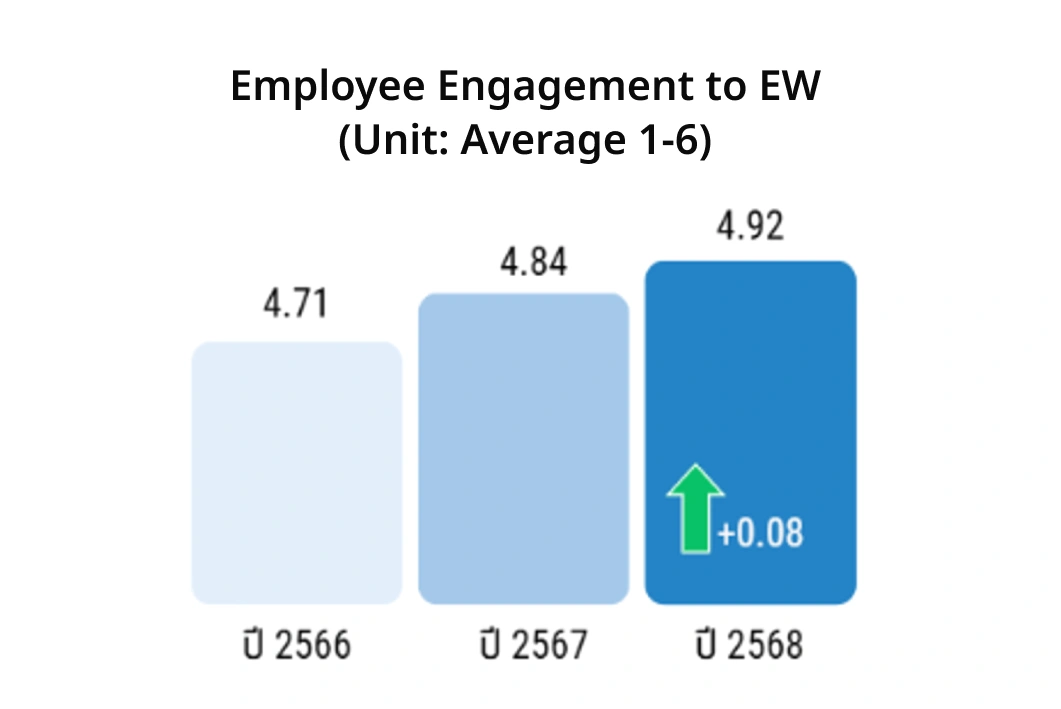
The Company places importance on employee engagement as a key indicator reflecting relationships, trust, and employees’ readiness to contribute to achieving organizational goals.
In 2025, the Company conducted an employee engagement survey using an assessment scale with a full score of 6. The results showed an overall engagement score of 4.92, representing a high level and a continued upward trend compared with the previous two years.
This increasing trend reflects the effectiveness of improvements in human resource management strategies, internal communication, and the development of a working environment that fosters participation and a sense of pride in the organization over the past three years.
Employee Satisfaction
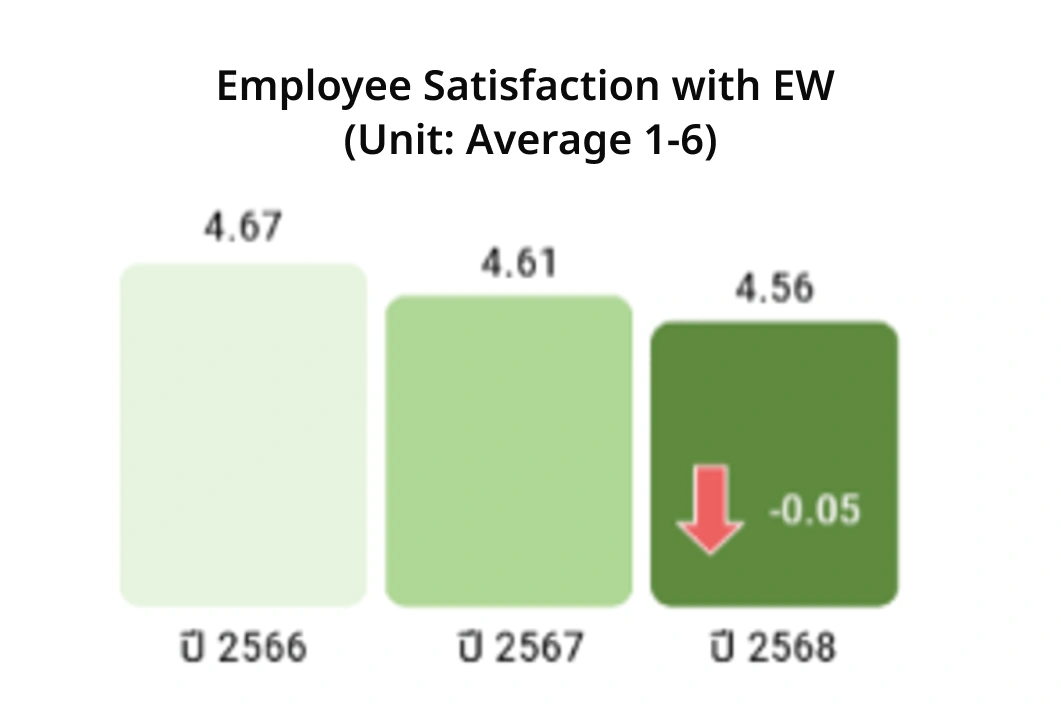
The Company conducts an annual employee satisfaction survey to assess employees’ perspectives and sentiments toward various aspects of their work.
In 2025, the overall satisfaction score was 4.56, slightly decreased from 2024 but remained at a good level, reflecting the overall stability of the working environment. A breakdown by dimension indicates that:
- The highest-rated aspect was workplace relationships, with a satisfaction level of 81.80%, reflecting positive relationships among colleagues and supervisors.
- The lowest-rated aspect was performance, management, and work processes, with a satisfaction level of 70.12%. The Company will use these results to continuously improve work processes, management practices, and internal communication.
The Company believes that systematically gathering employee feedback will help strengthen engagement and satisfaction, and support long-term organizational sustainability.