

Systematic Risk Management
Risk Management Structure
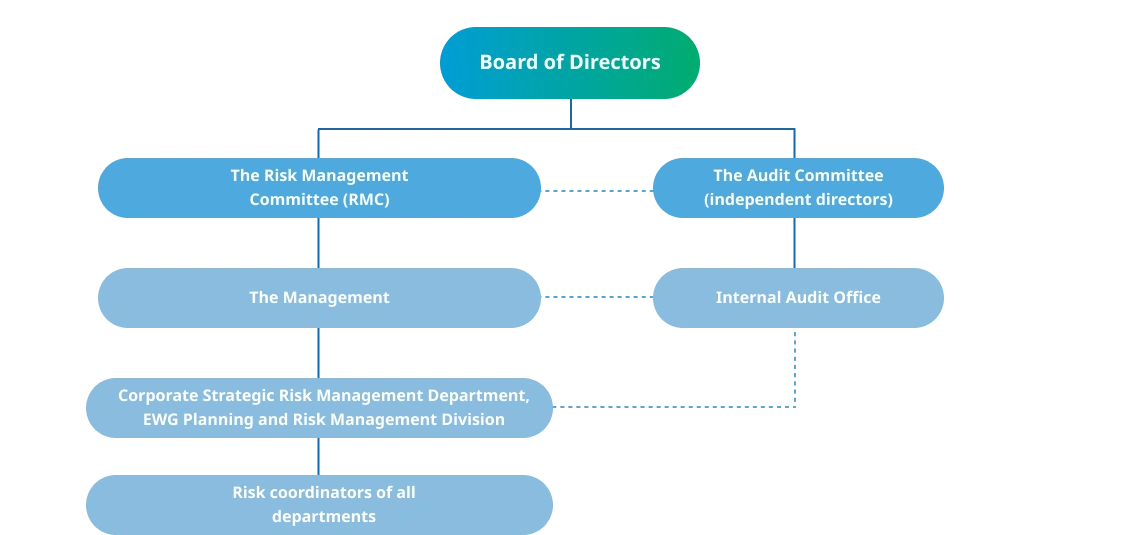
The Company manages risks on a sustainability-driven foundation, incorporating environmental, social, and governance (ESG) dimensions to prevent and mitigate potential business risks. This is achieved through a risk management framework aligned with the Committee of Sponsoring Organizations of the Treadway Commission (COSO) standards, along with analyzing and anticipating potential events from internal and external factors that may arise. Thus, operational priority, preventive and corrective measures, and effective management guidelines can be identified. These factors are then incorporated into the Company’s risk assessments and business opportunity evaluations.
Enterprise Risk Management is a core management and corporate governance policy that enhances operational efficiency, supporting the Company’s sustainable growth in alignment with quality management system requirements. This approach ensures a thorough understanding of the organizational context and objectives while also addressing the needs and expectations of stakeholders. The Company requires risk identification to cover six types of risks, namely 1) Strategic Risk, 2) Operational Risk, 3) Financial Risk, 4) Legal and Regulatory Risk, 5) Environmental, Social, and Community Risk, and 6) Information Technology Risk.
In addition, the Company requires all departments to conduct corruption risk assessments, applying the principles of the Thai Private Sector Collective Action Against Corruption (CAC) to identify types of activities or operational processes that may be exposed to corruption risks, such as requesting and/or renewing licenses with government agencies and participating in bidding processes for both public and private sector projects. Such risks can be categorized into three types, namely 1) Facilitation Payments, 2) Bribery to Avoid Penalties, and 3) Bribery to Obtain Business Opportunities. The Company also conducts human rights risk assessments in accordance with the UN Guiding Principles on Business and Human Rights to evaluate the likelihood and impact based on the criteria established by the Company.
If corruption risks or human rights risks with high risk levels are identified, control measures must be implemented to reduce the likelihood and impact to an acceptable level. Monitoring and random inspections are conducted by the Company’s Internal Audit Office. In addition, the Company assesses the impacts of climate change on its business operations. Global climate change, particularly prolonged drought conditions for 2–3 consecutive years, may lead to problems in water supply sources, affecting the stability of water sources and the efficiency of water management in cooperation with relevant agencies, potentially resulting in drought crises and water shortages.
The Company has also developed its Business Continuity Management (BCM) by establishing a holistic management system comprising a crisis management plan, crisis communication plan, and business continuity plan connecting all units across the organization.
Currently, Thailand places significant emphasis on ESG (Environmental, Social, and Governance) risks, which arise from environmental, social, and governance factors and may directly affect financial performance, business continuity, or the reputation of organizations. In particular, environmental risks are becoming increasingly significant as businesses, investors, and government sectors move toward more environmentally friendly practices. Thailand is currently undergoing an important transition to align with international standards, with policies being promoted in response to internal and external factors and global trends (emerging risks), such as the Net Zero target (net-zero greenhouse gas emissions) by 2050 and the introduction of the SET Carbon system by the Stock Exchange of Thailand. At present, many of these initiatives remain voluntary; however, they are likely to become increasingly mandatory in the future. Preparing for such developments will support financial performance, business continuity, and the Company’s long-term sustainable operations.

Measures to Address Emerging Risks
The Company recognizes opportunities to conduct its business in alignment with ESG policies, as well as the importance of establishing approaches to mitigate potential impacts arising from such policy changes, which may affect business competitiveness, financial performance, or the Company’s reputation, and ultimately influence sustainable operations. The Company has therefore implemented measures to address emerging risks continuously from the short term to the long term, as follows:
- Preparing for Regulations
- Proactive actions: Monitor upcoming regulations and consider early adoption to build confidence
- Integration into strategic planning: Analyze and review regulatory requirements, incorporate them into strategic plans, and establish clear targets.
- Capacity building: Enhance personnel capabilities to ensure teams understand the implications of regulations and relevant frameworks
- Leveraging Technology and Data
- Adoption of tools: Utilize digital platforms and tools to manage sustainability and greenhouse gas emissions data collected from various departments.
- Process improvement: Establish streamlined reporting processes that are aligned with regulations and can be verified.
- Strengthening internal controls: Develop controls over sustainability-related data, both financial and non-financial.
- Capturing Strategic Benefits
- Building trust: Strengthen investor confidence through consistent and comparable disclosures.
- Identifying cost-reduction opportunities: Utilize climate and sustainability data to identify opportunities for cost savings.
- Access to green finance: Align with market expectations to unlock access to green financing sources.
- Enhancing competitiveness: Strengthen the Company’s position in business value chains that increasingly require sustainability information.
The Company places importance on environmentally friendly operations across all processes, including improving the efficiency of water transmission systems, optimizing water management to reduce electricity consumption in pumping operations, maintaining pumping systems to ensure maximum efficiency, and adopting alternative energy and environmentally friendly innovations in raw water transmission processes to support sustainable operations.